Author: Jack Welsh

In February, LAAF’s Festival Programme Manager Jack Welsh was invited to present as part of A New Direction’s Principles Into Practice online panel.

A series of case studies exploring best practice in work for children and young people through the lens of the Arts Council England Investment Principles.

Jack discussed LAAF’s 22 project, which was produced by Penny Babakhani as part of LAAF 2021 festival.

The case studies explored:

  • Programming content that is relevant to and reflects the concerns faced by young people
  • How to create environmentally sustainable work and workplaces
  • Ways your work can have the most impactful connection with the principle
  • How to create programmes based on playful activism

Read LAAF’s case study: www.anewdirection.org.uk/training-cpd/principles-into-practice/environmental-responsibility/liverpool-arab-arts-festival
Read other case studies from the event: www.anewdirection.org.uk/training-cpd/principles-into-practice/environmental-responsibility

Kamel Saeed, an emerging UK-based Iraqi creative, presents a fascinating audio journey of discovery into the creatives that once called the Iraqi capital home. This new podcast series is being exclusively launched as part of Liverpool Arab Arts Festival 2021.

With guests including artists, writers and scholars, Saeed offers listeners a glimpse into an extraordinarily rich period of world history by exploring the lives of just a few of the creatives that have played a part in the story of Baghdad – and continue to do so to this day.

Said to have been crushed to death by a collapsing pile of books, Al Jahiz (776-868) was an Iraqi bibliomaniac, eccentric, and prolific writer of some 260 books. His magnum opus, Kitāb al-Ḥayawān (كتاب الحيوان) ‘Book of Living Things’ is an unusual encyclopaedia, largely unknown in the West, illustrating and describing over 350 species of animals. His distinct style of prose ‘magnified the trivial so that it became important and diminished the important so that it became trivial’. Over a millennia later, his work is still enjoyed across the Arab-speaking world.

This episode of What Happened in Baghdad is commissioned by Liverpool Arab Arts Festival and co-produced with the Whitworth, The University of Manchester. The series is made possible with funding from Arts Council England.

Illustration: Noura Andrea Nassar

Future episodes

Episode Two: Abu Nuwas

‘Pour me seven, back to back’ and ‘There’s no surgeon like the glass’ aren’t exactly titles to poems you’d expect from an Arab poet. Then again, Abu Nuwas wasn’t your average poet. The Arab-Persian Abu Nuwas (756-814) is one of the most divisive yet irrefutably gifted Arabic poets. Having mastered and advanced every genre of contemporary poetry, he went on to pioneer five more. A libidinous hedonist and an alcoholic with an obsession with wine, a fifth of his whole poetic output is dedicated in praise.

Illustration: Noura Andrea Nassar

Episode Three: Al Maarri 

The blind Arab poet, philosopher and writer Al Maarri (973-1057) was a vegan before it was cool. An outlier, he held other unorthodox views for his time: he was irreligious, a rationalist and a pessimist. His poems are at once beautifully lyrical and philosophically profound. Testimony to the universal appeal of his work, his influence spans continents: a translated copy of his poetry was found in Franz Kafka’s library, and he was one of Khalil Gibran’s dearest poets.


About the presenter

Kamel Saeed was born in Baghdad in 1997 and was educated there until the age of 9, when his family fled war in 2006. After arriving in the UK, he learned English and completed his primary and secondary education. He went on to study English Literature, graduating in 2018. Since then, he has interned at English Heritage and The Collection Museum, Lincoln, and has been consulted on diversity and inclusion within the cultural sector. What Happened in Baghdad evolved out of independent research he has undertaken into early Islamic civilisation and draws on his own Iraqi and Arab heritage.

About the guests

Hanouf Al-Alawi works at the British Museum leading a national programme that co-curates youth cultural projects. Before joining the British Museum, she worked at the Natural History Museum as a Learning Volunteer Engagement Manager, recruiting and training diverse volunteers who deliver engaging and inspiring object-based learning to children, youth, and adults. Prior to this, she worked at Kew Gardens as an Education Officer, managing a pioneering project that co-curated with pupils and their families, school museums that represented the pupils cultural diversity. Before moving to the UK, she worked in the Middle East developing and delivering pioneering projects that improved access to and quality of education for children and youth.

James E. Montgomery is Sir Thomas Adams’s Professor of Arabic, Fellow of Trinity Hall, at the University of Cambridge, and an Executive Editor of the Library of Arabic Literature. His latest publications are Loss Sings (2018), a collaboration with the Scottish artist Alison Watt, ‘Antarah ibn Shaddād: War Songs (2018) – and a translation – with Sophia Vasalou, and The Philosopher Responds: An Intellectual Correspondence from the Tenth Century (2021). His translation of Ibn al-Muqaffa’s Kalīlah and Dimnah: Fables of Virtue and Vice, with Michael Fishbein, will be published this autumn.

Bryony Dunne is an Irish artist and filmmaker based in Athens, who traces the overlaps between documentary film, cinema, photography and the natural world. She develops research-driven projects to explore the power dynamics and fantasies of control that humanity projects on to nonhuman others and nature; oftentimes, she uses fact-based fictions and hypothetical futures to build these interconnected narratives.


22, the creative anthology commissioned by LAAF as a response to COP26 is to be exhibited at Open Eye’s Digital Window Gallery until 13 February.

22 is a creative anthology by Arab artists from 22 countries across the Middle East and North Africa. Commissioned by Liverpool Arab Arts Festival as a rapid response to COP26, the artistic works include music, visual art, poetry, illustration and photography and highlight the disproportionate impact the climate crisis is having on the countries and communities living within the MENA region.

From water shortages to population displacement, changes in climate and failing crops, the impact of the climate crisis is worsened by the continuing hangovers of conflict and colonialism, meaning the issues already existing in the MENA region are exacerbated.

As global leaders gathered in Glasgow for COP26, each of the 22 artists provided an insight into how the climate crisis is affecting their community. As a creative anthology it creates a time capsule at a crucial moment in history.

Arab voices are not strongly heard within the climate crisis conversation in the West, despite the disproportionate and severe effects those on the ground are facing. Capturing the hopes and fears of a generation of Arab artists, 22 reflects the range of perceptions and preoccupations of those living in or with heritage of these specific Arab areas.

22 exhibits at Open Eye as the Look Climate Lab 2022 launches, ahead of the Look Photo Biennial 2022, the Climate Lab is a series of research projects on climate change. Read more here

The show will be played on the digital screen 11am-4pm Wed-Sun, between Wed 19 Jan – Sun 13 Feb

Explore 22 below

www.arabartsfestival.com/22project 

For the first time, Liverpool’s arts organisations have come together in a brand new campaign promoting Liverpool’s impressive cultural credentials.

The Everyman and Playhouse Theatres, Katumba, Bluecoat, Liverpool Philharmonic, Metal Culture, Homotopia, FACT, DaDaFest, The Comedy Trust and Liverpool Arab Arts Festival are just some of around 50 names forming part of the Culture Collective campaign which proudly highlights the city’s vast and diverse culture offer. 

Billboards and advertising hoardings across Liverpool and Manchester will be emblazoned with slogans including ‘The Place is Liverpool. The Time is Now’, ‘Every Language. Every Accent. Every Artform. Every Style.’ and ‘Welcome to the city where the best stories begin…’

Local artists, Raven and Dayzy, are joining forces with Liverpool-based video director Jack Whiteley and GoPlay recording studios to bring the campaign to life with a specially created soundtrack which pays homage to the city’s enviable cultural scene.  This will be showcased on the official website – www.visitliverpool.com/culturesclub – and on cultural social media channels. 

The arts sector has been one of the hardest hit as a result of the Coronavirus pandemic – with many venues closed for long periods or unable to curate in-person programmes due to changes to restrictions.

The Culture Collective is an initiative aimed at attracting local and regional visitors back to the city, shining a spotlight on the huge array of establishments that make up the region’s live performance, music and dance, galleries and exhibitions, film and digital technologies, comedy, festivals and museums.

This new way of collaborative working means resources, including the wealth of creative skills and experience, can all be shared and cross-promoted. 

The importance of the sector was highlighted by the most recent figures which show Liverpool’s leisure, creative and cultural industries:

  • Bring in around £3.3bn to the city region each year
  • Equates to 38 per cent of the city’s economy
  • See a business rate contribution of 49.8 per cent. This means £270.5million is invested in core services such as social care, health care and in education. 
  • Supports 60,000 jobs 

An analysis of 27 cultural organisations funded through the city council’s Cultural Arts Investment Programme showed that in 2021/22, 250,487 people attended live events – significantly lower than the 4.5million recorded in 2019/20. 

The Culture Collective campaign has been funded through the Government’s Culture Recovery Fund which is administered by Arts Council England, some of the cultural organisations involved and Liverpool City Council. A second phase of the project will launch later this year.

Reaction

Liverpool City Council’s Cabinet Member for Culture and Visitor Economy, Councillor Harry Doyle: 

“This is a hugely exciting campaign involving around 50 cultural organisations – from names that need no introduction, to those whose work is less well known but who are just as awe-inspiring – and they’re all working together to send out the message that their doors are open and they can’t wait to welcome back audiences – old and new. 

“Despite the horrendous challenges this sector has faced over the past two years, their resilience is inspiring and there is a real sense of positivity about the potential of 2022 and the return of local, national and hopefully international visitors. They simply can’t wait to show people what’s in store this year – from big nights out and reflective moments, to belly laughs and enjoying that shared moment of joy with others. 

“Our city’s creative teams are itching to welcome people back and by working together we can shine a spotlight on the city once again and see our much-loved cultural sector come alive and thrive.” 

Mary Cloake, Chief Executive, the Bluecoat:

“As one of the city’s best loved arts venues, the Bluecoat is delighted to be part of a campaign to remind people of Liverpool’s rich cultural offer and the joy to be found in seeing a show, spending time in a gallery or doing something creative. 

“Liverpool needs people to thrive, and Bluecoat is playing a key part in reinvigorating the city centre alongside other cultural attractions. We’ve done our best to ensure our historic building is safe for visitors so that people can start to enjoy culture again. While we were closed during lockdown we transformed our entrance area so if you haven’t visited recently come down and see our fresh new look.” 

Michael Eakin, Chief Executive of Liverpool Philharmonic: 

“We’re delighted to work with Culture Liverpool and arts organisations across our city on the Culture Collective campaign, which will highlight Liverpool’s world-class cultural offer. 

“As with the culture sector as a whole, the pandemic has posed significant challenges to Liverpool Philharmonic, but since Autumn 2021 we have once again presented a busy and artistically vibrant programme of visiting artists from around the world. We are looking forward to continuing to welcome our audiences back to Liverpool Philharmonic in the year ahead.”

Elinor Randle, Artistic Director – Tmesis Theatre, and spokesperson for the COoL Collective (Creative Organisations of Liverpool) which represents 27 key arts organisations based in the Liverpool City Region:

“We are very proud of the collective and the collaborative way we work across a wide variety of art forms and communities. This campaign is exciting as it highlights the rich diversity of incredible work our city region has to offer. We look forward to sharing work, collaborating and welcoming visitors to our festivals and events in 2022!”

…

THE PLACE IT LIVERPOOL. THE TIME IS NOW.

Many thrilling voices. One incredible story…

We’re proud to be one voice among the many that make up our city’s amazing cultural story, and we hope you take time to discover what we have to offer.

But remember that there are also others who deserve to be heard too, and we’d love to introduce you to some of these wonderful venues and organisations that share our home.

Because the place is Liverpool.

The time is now.

And this is the city where the best stories begin.

*

Everyone’s invited.

Liverpool is rich with restless creators – a bubbling stew of artists, companies, groups and venues dedicated to ingenious invention, to the spice and sparkle of new ideas for you, your friends and family to enjoy.

From names that need no introduction, to those whose work is less well known but just as vivid, we can’t wait to show you what we’ve got in store. From big nights out and reflective moments, to belly laughs and quiet sighs, our city’s creative teams are itching to welcome you back to where the best stories happen…

WWW.VISITLIVERPOOL.COM/CULTURESCLUB

CREDITS:

Film:

Starring Dayzy & Raven

Directed & Edited by Jack Whiteley 

Produced by Carl Davies at FACT 

Director of Photography: Jamie Haigherty

Focus Puller: Carl Davies 

Gaffer: Chris Moore at Tunstall Film Services

2nd Unit DOP: Jack Whiteley & Carl Davies

Drone Footage: Ant Clausen

Stylist: Beth Jones

Hair & Make-up: Eve Jenkins 

Colourist: Juliette Wileman at Absolute Post 

Sound Design: Joe Wills 

Special Thanks: Laura Johnson, Josh Rowe, Clare Wilde, Jessica Fairclough, Farhana Khan, Dominic Beaumont, Jay Hynd, David Wright, Olivia Graham, Sumuyya Khader, Joanna Rowlands, Jack Welsh, Wesley Storey, Mark McNulty, House of Suarez, Lili Taijaard, Ally Goodman, Emily Guest, Michael Parry, Melodic Distraction, 24 Kitchen Street and Invisible Wind Factory.

Soundtrack:

Written & Performed By: Dayzy & Raven

Produced By: Fourthirteen

Engineer & Mix By: GoPlay Studios

Mix & Master: Loft Mastering

Music Direction By: Yaw Owusu, The Playmaker Group

Partners: 

20 Stories High | All Things Considered Theatre | Arts Groupie | BlackFest | Bluecoat | BrazUKa | Collective Encounters | DaDaFest | dot-art| FACT | First Take | Focal Studios | Homotopia | International Slavery Museum | Katumba | Kitchen Sink Live | Lady Lever Art Gallery | Liverpool Arab Arts Festival | Liverpool Biennial | Liverpool Empire | Liverpool Everyman & Playhouse Theatres | Liverpool Irish Festival | Liverpool’s Royal Court | Luma Creations | Maritime Museum | Merseyside Dance Initiative | Metal | Movema | OLC Productions | Open Culture | Open Eye Gallery | Pagoda Arts | Paperwork Theatre | Royal Liverpool Philharmonic  | Squash | Sudley House | Tate Liverpool | The Atkinson | The Black-E | The Comedy Trust | The Windows Project | Tmesis Theatre | Unity Theatre | Wired Aerial Theatre | World Museum | Writing on the Wall

This project has been supported using public funding by Arts Council England (https://www.artscouncil.org.uk/) and Culture Liverpool (https://www.cultureliverpool.co.uk/) the culture department of Liverpool City Council (https://liverpool.gov.uk/).  

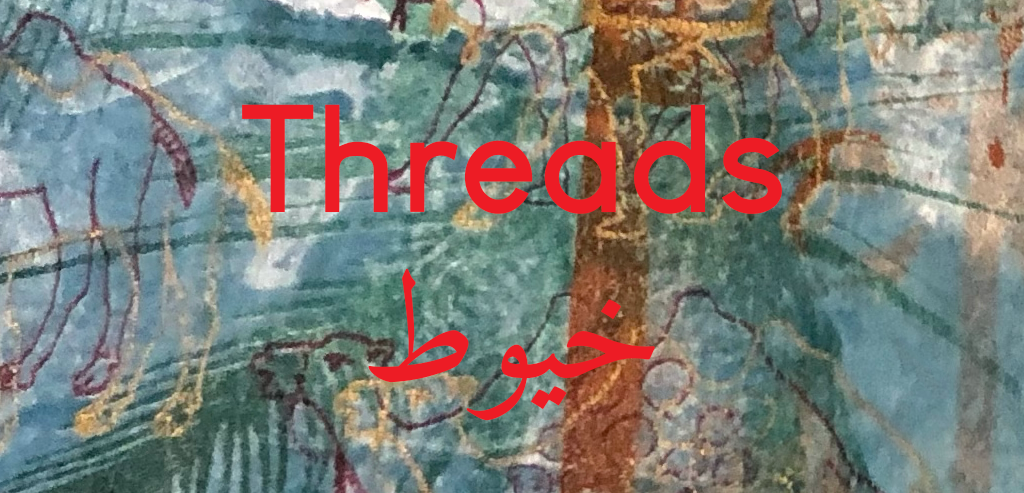
We are delighted to invite you to watch Threads, a film bringing together three Arab women artists from Syria, Lebanon and Sudan, weaving a story of migration, songs of the Earth, of disability and the passage of time.

In a journey through storytelling, music, and visual poetry they explore how, while the rich tapestry of our lives may be different, a thread runs through them to bring together a sisterly home that is unbound and timeless.

Inspired by the nomadic Bedouin, one of the many indigenous communities in the Arab world who continue to be marginalised through aggressive, extractive ‘development’ practices, Threads brings together the impact of time, culture and migration in a scripted spoken word, accessible performance, with music and a mixed media installation.

Storytelling is performed by Alia Alzougbi and accompanied by original and adapted music performed by Rihab Azar on the Oud. The focal point of the installation is a sculptural work that brings numerous threads, made up of a vast range of colours, and created by Omeima Mudawi-Rowlings.

Part of Liverpool Arab Arts Festival, this is a digital, accessible performance, available to watch for free.

Select the version you would like to watch below.

Watch Threads with English subtitles

Watch Threads with Audio Description

Threads is commissioned by Liverpool Arab Arts Festival, with support from DaDa, funded by Arts Council England and Liverpool City Council.

Watch on YouTube

Liverpool Arab Arts Festival in collaboration with Creative Destruction has produced a series of online conversations titled ARTISTS / IDEAS / NOW. This series is part of LAAF’s four-month festival focused on the climate crisis, and invites leading creatives, activists and thinkers to explore the complexities surrounding the climate emergency.

This conversation looks at the connection between patriarchy and the climate crisis. How is the climate crisis impacting women and people of marginalised genders? Are there feminist solutions to the crisis – perhaps rooted in cultural traditions and practices which have been upended by consumerist habits? How can artists help illuminate the parallels between society’s  treatment of women and nature?

Watch here

The panel will be made up of artists who have contributed to the 22 project
Ala Buisir is a documentary photographer born in Ireland with Libyan roots. A graduate with a BA in Photography from TU Dublin. Then an MA in Journalism from DCU and currently doing a PhD by practice in UL. Her work documents the social and political tension around us today. The aim is to raise awareness by presenting events through different perspectives in hopes that it may also bring about change.Website: www.alabuisir.com
Juliana Yazbeck is an award-winning actor, writer & musical artist. As an actor, she is best known for her roles as Niqabi Ninja in Sara Sharaawi’s play Niqabi Ninja, Roza Salih in Glasgow Girls (National Theatre of Scotland) and Yara in the Emmy-winning series Shankaboot (BBC World Service).Juliana’s debut record SUNGOD was awarded PRS Foundation’s Women Make Music Award. Juliana recently played a sold-out show at London’s Electric Ballroom (2020). In 2019, Juliana played London’s ULU alongside Sudanese icon AlSarah, headlined the National Theatre River Stage and Liverpool Arab Arts Festival, and was nominated for the Arab British Centre’s Award for Culture.Juliana also writes regularly. Her words feature in gal-dem magazine and on Medium.com.Twitter: @julianayaz
Maha Alasaker is a visual artist based in Kuwait. She is a 2014 graduate from the International Center of Photography.Through her artwork, Maha tries to gain a deeper understanding of herself while attempting to engage issues of culture and identity. Her curiosity centers around how a woman’s upbringing affects identity and self-worth.Maha’s projects have been displayed in numerous exhibitions in New York City and London, as well as the United Arab Emirates and Kuwait. Magazines such as Harper’s Bazaar, Vogue, Marie Claire and Rolling Stone have featured her work.In 2019, Maha published her first photo book, “Women of Kuwait”, which was then acquired by the Getty Research Institute and The Thomas J. Watson Library at the Metropolitan Museum of Art.


Liverpool Arab Arts Festival recognises the need for everyone to work together to tackle the impact and effects of the climate crisis. The disproportionate impact on people and communities living in the Middle East and North Africa means the climate crisis risks having the harshest consequences on those with the least power to affect change. 

We believe it is important that we take ethical and moral responsibility for our impact on the environment. We can do this through our practices and activities. As an arts organisation we report on the work we do to mitigate and monitor our impact through our practices and activities. It is important that we act as an advocate, working in partnership with artists and organisations, sharing best practice and encouraging those we work with to reduce their own impact. 

The objectives of our environmental guidance are;

  • To share information with our partners and artists, identifying and providing training examples to encourage learning and development
  • To hear from different communities and people to continuously explore how diverse voices and experience can be heard 
  • Learn best practice and continuously review our environment policy and work to reduce our impact, examining energy use, transport, waste, audience and artist travel and ethical purchasing
  • To bring environmental decision making to Board level, ensuring its is integrated into our business plan

For artists and organisations

As an arts organisation based in Liverpool with an international reach, LAAF recognises that for artists and partner organisations outside of the UK, transport and travel could have a significant environmental impact. We have to take this into account, and have a criteria based on the impact of a work and its ability to raise the profile of an issue.

With that in mind, our environmental guidance for artists and organisations is;

  • To include environmental impact on any proposal or reporting to be part of LAAF
  • To make best practice part of working practice
  • Where travel is involved, to explore the most sustainable travel method, or to maximise opportunity while in the UK and reduce additional travel impact
  • To examine energy use, audience travel and ethical purchasing when making a proposal 

Liverpool Arab Arts Festival (LAAF) is inviting artistic proposals for our 2022 festival.

The festival will be held in July, 2022 and it will be twenty years since the first Liverpool Arab Arts Festival was held in the city.

Whether in Liverpool or online, we work with Arab artists who are living and / or working in the UK, in an Arab country or within its communities, or identify as having Arab heritage. 

As a festival, we work with artists across a range of artforms, including: music, performance, theatre, literature, spoken word, visual art and more. You can see examples of previous festival programmes on our website.

Proposals can be in any of these artforms. Outputs can include live or digital performances, events, artworks, exhibitions, workshops, public realm works, talks, panel discussions or young people’s activities. The deadline to apply is 7 January 2022. 

Festival Theme

Next year our theme explores our language, how it sits at the heart of our culture, but also how we use it to connect. How we understand each other, how we come together to engage and cross our cultural boundaries. This is how we create a bridge, connecting language and culture. It is how we discover what we have in common and how we communicate. If language is at the foundation of our culture and identity, how we translate to understand each other provides a valuable meeting point.

By its very nature, translation is not purely rooted in language. It can be how we navigate our mixed identities, how we code-switch, changing how we speak and appear when in different situations.

The way we, and our language, is translated, can be influenced by many different things. In literature, there is a focus on how the translation of a text can impact on how a culture, a heritage or identity is perceived. We know how powerful images can be in presenting how a culture can be understood, language is the same. Translation is a powerful tool, but it can also portray power, a dominance over language which can have colonialist implications.

In 2022, Liverpool Arab Arts Festival explores the meeting points for language, the intersections are the places we want to explore.

What we’re looking for

Our call out is divided into two parts:

  • New Artist Commissions

Each year we support several artists in realising new creative ideas. This new work must be developed beyond the concept stage to feature in the 2022 festival.

It must be a considered proposal that could feasibly be staged within the festival, either as a physical or digital event. It must be engaging and thought-provoking, relevant to the theme of Translations.

If you are interested in submitting, please read our brief and how to apply.

Brief

We present work by emerging or established artists who are living and / or working in an Arab country or within its communities, or identify as having Arab heritage.

We welcome proposals in any artform including music, performance, theatre, literature, spoken word, visual art, installation, sculpture or any combination of these. Your work may take place physically or online.

For a new commission this work needs to be high-quality and relevant to our audiences. We connect with arts lovers and those interested in Arab arts and culture based locally, regionally, nationally and internationally.

The work can be presented as part of our festival. It can be made in collaboration, either with another artist or community. It can potentially be hosted by a cultural organisation physically in Liverpool. It has to be challenging but needs to be accessible for our audiences.

  • Existing Work

Do you have a piece of existing work that you feel would be ideal for LAAF and the festival theme? Could it be re-staged or re-purposed for the festival? Is it a touring work?

If you are an emerging or established artists who are living and / or working in an Arab country or within its communities, or identify as having Arab heritage, and you have an artwork or performance piece you would like to be considered as part of Liverpool Arab Arts Festival, please complete the form below.

Requirements

  • The proposal/work must be artist-led. You could partnering with another organisation or working within a community, but an artist must be at the centre of this piece
  • Our theme is not prescriptive, but we would like it to be responded to. As long as you can articulate its influence.
  • If submitting a proposal for a new artist commission, this must be a new, original piece of work that you own the rights to.
  • While we can support travel fees, the budget is limited. A large group of artists with international travel would not be appropriate.
  • All our commissions are subject to funding. This means that while we will support the development of the work and artist time, we cannot fund rehearsals and space hire during its development.

We have compiled advice for artists to consider the environmental impact of their work and commission

Please read our Environmental Advice for Artists

The deadline to apply is 7 January 2022

Thank you to everyone who applied for this year’s festival. We will be in touch in the future. Given the volume of applications, this is likely to take several weeks. 

Illustrated view from a bridge in Cairo. It is summer and there are palm trees in the foreground and pyramids in the background.

This film-poem is an invitation to reflect on the situation in Yemen, which is currently known as the “worst humanitarian crisis in the world”. Not much work is being done in Yemen regarding climate change, and especially the threat posed by the floating oil storage vessel, FSO Safer, in the Red Sea. The tanker is likely to explode or sink according to experts, which will cause an environmental disaster that is difficult to contain. This will affect the lives of many, not only in Yemen but also in other countries. However, it seems that the world is still in denial since the danger is invisible to many, and there is no interest in looking beyond the self or diving to explore the unseen.


Photo of Saba HamzaSaba Hamzah (@Saba_Hamzah) is a Yemeni poet-scholar, writer, and educator. She received her master’s degree in Gender Studies from Utrecht University. Saba’s main devices are line and light and the moments in between. Her work questions power structures of societies at large using art and literary interventions as tools for social mediation and transformation. Her scholarship activates silences in living archives of women in the conditions of diaspora and exile.

https://www.sabahamzah.com/